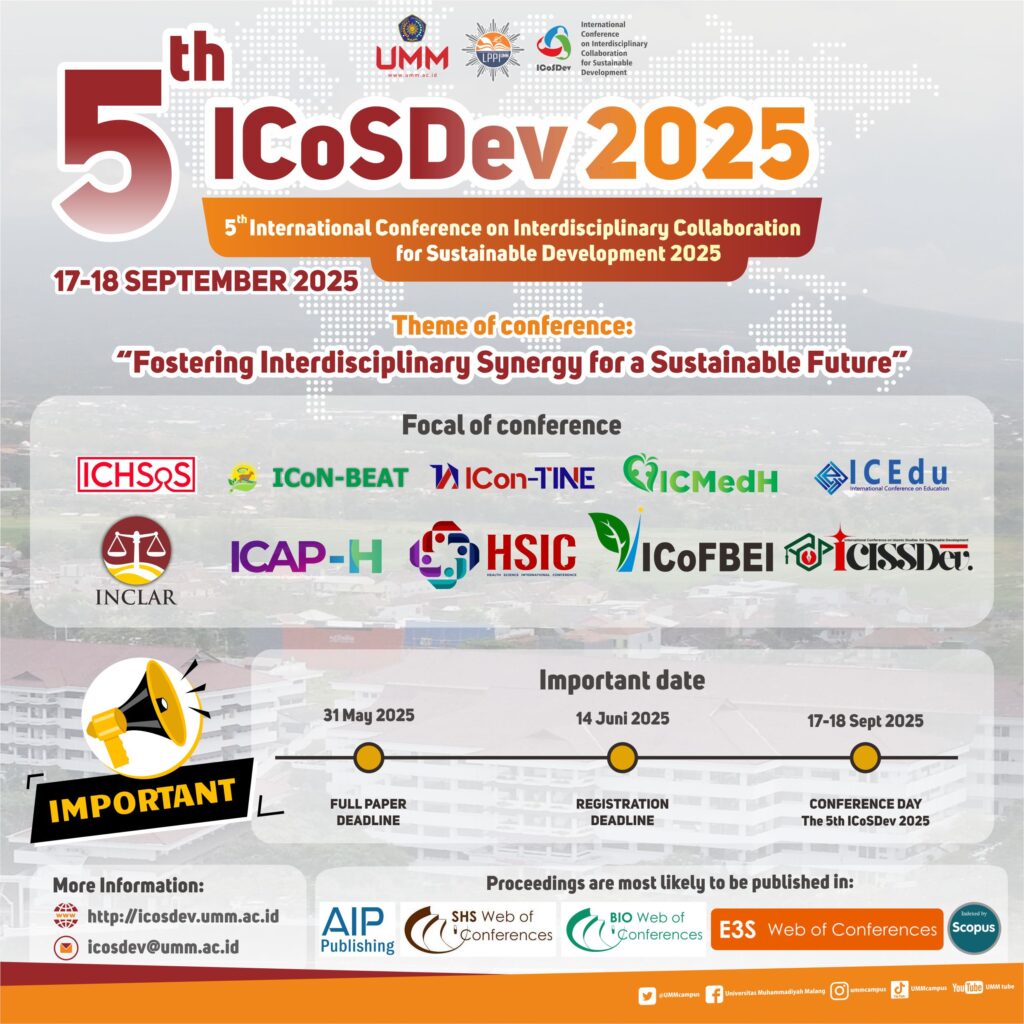
International Conference on Interdisciplinary Collaboration for Sustainable Development (ICoSDev) 2025
Rapid social change and information technology transformation have required academics to adapt and innovate competitively to develop scientific approaches and perspectives to solve various problems in all sectors of human life. Human problems' complexity cannot be solely resolved with approaches and perspectives from a single academic discipline. Numerous studies have revealed that using one particular academic discipline's perspectives to solve human problems is deemed futile as it may generate counterproductive results.
A clear illustration can be seen in the aspect of environmental damage as it is not sufficient to investigate such a problem simply through the ecological science perspective. The ecological approach can only reveal that environmental damage is caused by interaction patterns between living things and the environment that no longer runs well. The causes of environmental damage are not only related to the interaction patterns; there are some other determining factors, like environmentally unfriendly human behavior (it is seen from the sociocultural perspective) and political and governmental interests that are not in line with sustainable environmental development (it is explained through by political science perspective). Therefore, more elaboration from other disciplines, such as socio-cultural, educational, economic, management, technological, legal, political, and governmental perspectives, is imperative so that the causes of environmental damage can be comprehensively unveiled. As a result, complete concepts of environmental damage problems can eventually be generated.
Multiple perspectives and approaches in explaining development problems result in various concepts for generating policy recommendations that may solve the problems. Moreover, these can be considered reliable instruments to achieve sustainable development goals such as poverty, education, equitable development, technology, information transformation, global warming, corruption, terrorism, and other problems faced by countries worldwide.
For instance, poverty and unemployment is no longer adequate to be justified solely through economic approaches and perspectives that measure the standard of human prosperity from the financial stability aspect. It needs to be investigated using other approaches, such as the socio-cultural approach, which generally reveals that human prosperity, happiness, and stability are influenced by its social members' togetherness and intimacy.
Besides, educational development can not only be explained by the approaches and perspectives of technological development and human transformation towards modern life, international competitiveness, and increasing social status. These perspectives somehow may produce new issues in human life, namely segregation of social classes, which lead to social disharmony. Hence, educational development needs to be explained and understood with more humanist perspectives, like socio-cultural and human development perspectives. As a developing country, Indonesia needs to realize that educational development is to be established from multiple perspectives as the basis for its human-development-policy formulation.
Meanwhile, in addition to the normative legal approach, corruption also needs to be elaborated through other perspectives, like information technology, socio-culture, education, government politics, economics, and religion. If this issue is only highlighted from the normative legal perspective, it may be challenging to uphold justice and reduce corruption. Information technology can effectively be utilized to justify corruption so that it can be minimized and controlled. Technology such as artificial intelligence (AI) can also be used to record, tap, and monitor state officials who have access to state resources. Corruption is also inseparable from the educational problems existing in a country; this condition can only be explored through the collaboration of educational, political, economic, and religious perspectives.
Scientists have realized that globalization and shifts in information technology require them to prioritize the interdisciplinary collaboration approach to understand and resolve various problems, especially those related to sustainable development issues. The interdisciplinary collaboration approach is widely used to apprehend and explain environmental damage problems, exploration of natural resources, and health issues. However, many of the latest scientific publications reveal that interdisciplinary collaboration has become a progressively popular approach introduced to address other social problems, particularly information technology, digitization, and human activity robotization. This, eventually, leads to the invention of new terms, such as technology for society, collaborative governance, intergovernmental, society partnership, and others that emphasize cross-sectoral and cross-disciplinary cooperation.
University of Muhammadiyah Malang (UMM), as the leading private university in Indonesia and the most prominent one in East Java, has taken its part to contribute to the development of research and publications emphasizing on the interdisciplinary-collaboration approach to investigate various developmental problems and support the realization of sustainable development goals. The goals specifically refer to education, information technology, economic development, political and governance, ecology, agriculture, animal husbandry, human character and behavior, socio-culture, public health, law, and artificial intelligence. This approach has been set towards the accomplishment of human development, local wisdom empowerment, and national development.
UMM seeks to actualize the interdisciplinary-collaborative approach into an international conference under the theme of International Conference on Interdisciplinary Collaboration for Sustainable Development (ICoSDev). The international conference oversees six international conference groups, i.e., International Conference on Social and Political Issues on Sustainable Development in Post Covid-19 Crisis (ICHSos); International Conference on Education and Psychology (ICEduPsy); International Conference on Legal Reform (ICLAR); International Conference on Bio-Energy and Environmentally Sustainable Agricultural Technologies (ICoN-BEAT); International Conference on Technology, Information and Engineering (ICon-TINE); and International Conference on Medical and Health Sciences (ICMedH).
This international conference aims to disseminate ideas and experiences in implementing the interdisciplinary collaboration approach for sustainable development. Thus, it is highly dependent on the support and involvement of many parties, both domestic and foreign parties, with the bases of educational institutions, research, publications, business, and other institutions that are either directly or indirectly connected to sustainable development issues. Hence, UMM is looking forward to receiving support from all parties to organize the event properly, as it will eventually contribute to the development of science and practice in human life.